The As-Built Map Problem: Why Most Courses Lose Track of Their Own Infrastructure

Most courses can’t say exactly where their own pipe, valves, and wire are buried, and it costs them every week.
In a Turfile survey of superintendents, 87% said they have no reliable way to document and reference their past work, and only 13% reported having a system they trust. The rest run on memory, scattered paper, or nothing at all.
That gap shows up the first time you need to dig.
Key takeaways
- Only 13% of operations have a documentation system they trust. The other 87% rely on memory, paper, or no system whatsoever.
- 40% of operations would lose 25% or more of their operational knowledge if a single key person walked out the door.
- 40% lose 5 or more hours a week just locating buried infrastructure like valves, heads, and wiring, and some report losing 10 to 20 hours.
- Mapping and finding infrastructure was the single most common frustration reported by superintendents.
- Onboarding a new staff member averages around 18 hours, and that number climbs when the course isn’t documented.
What is an as-built irrigation map?
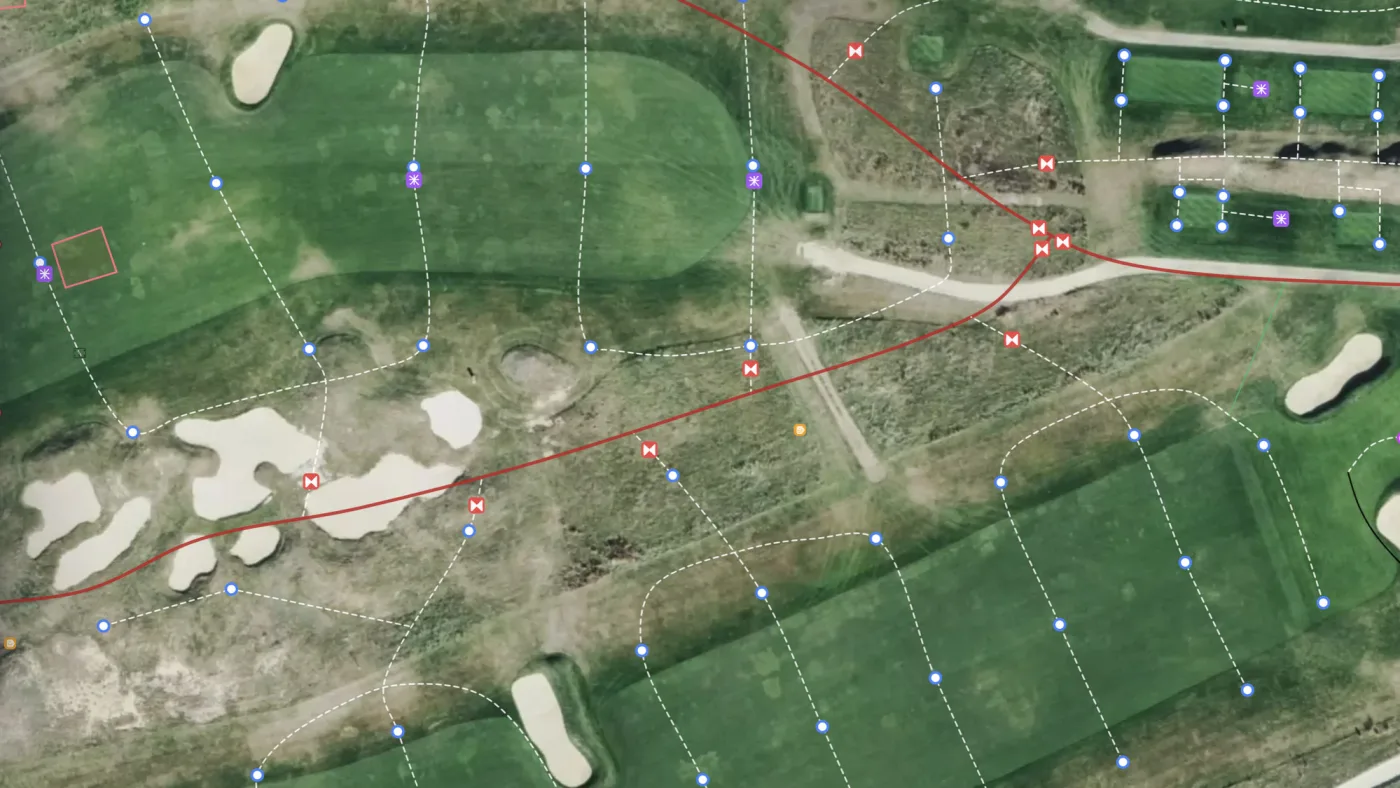
An as-built irrigation map is a documented record of where every head, valve, pipe, wire, quick coupler, etc, actually sits on the course, kept up to date as changes are made.
The “as-built” part matters. The original design drawings from when the system went in show where everything was supposed to go. The as-built shows where it actually ended up after the contractor hit rock, rerouted a lateral, or added a head that was never on the plan.
Over a few decades of repairs, additions, and reroutes, the design plan and the real course drift apart. A current as-built closes that gap. It reflects the course as it is today rather than as someone drew it in 1994.
Why do so few courses have a usable one?
Most courses started with a plan, then stopped updating it the day the irrigation crew left.
The map goes out of date one small change at a time. Someone repairs a mainline break in February and patches in eight feet of new pipe on a slightly different line. Nobody updates the drawing. Three years and forty small changes later, the paper plan no longer matches the ground, and the only accurate version is in the head of whoever has been there longest.
Superintendents do value the map, but keeping it current is one more job on a list that’s already too long, and the benefit only shows up the day a valve won’t shut off. Paper plans get coffee-stained, folded into a truck door pocket, and eventually lost. Most operations never had a living document to begin with, just a roll of as-builts in a cabinet that nobody trusts.
It also explains why two thirds of operations run on memory or paper. The map technically exists, but it isn’t usable when you need it.
What does it cost you when the map lives in one person’s head?
You’re one resignation away from losing how your course actually works, and you lose hours every week in the meantime.
Start with the hours lost every week. 40% of operations lose 5 or more hours a week locating buried infrastructure, and some report 10 to 20 hours gone to it. That is the daily symptom of a missing map, and it shows up most often as hours spent finding buried valves and heads before the real work even starts.
Then there’s the bigger risk. 40% of operations would lose 25% or more of their operational knowledge if one key person left. When the map exists only in a single person’s memory, the whole operation depends on that person. If they retire, get hired away, or are out for a surgery, the knowledge of where the wire runs goes with them.
This is also a training cost. A documented course is also far faster to train new staff on, which is part of why onboarding a new crew member takes around 18 hours and climbs higher when nobody can point a new hire to where things are.
How do you build an as-built map that stays current?
Start with what you already have, then make updating it part of the repair instead of a separate project.
Don’t try to map the whole course all at once. Begin with the parts that cost you the most time. Superintendents in the survey named the same culprits over and over: finding valves and keeping up with irrigation repairs, mapping irrigation lines and heads, and mapping the course from square footage down to quick couplers. Map those first. For the step-by-step version, see our guide on how to make an as-built map of your irrigation system.
Then change the habit. Every time the crew opens a valve box or repairs a line, that’s the moment to record what’s actually there: location, what was changed, a photo. A map updated at the point of repair stays current, while a quarterly catch-up session tends to get skipped.
The format matters less than the habit, but a shared, searchable map is far more useful than a paper roll. The whole point is that anyone on the crew can find the answer without calling the one person who knows. When the documentation is digital and tied to a location, the knowledge stops being a single point of failure.
Frequently asked questions
What is the difference between a design plan and an as-built map? A design plan shows where the irrigation system was intended to go, while an as-built map records where every head, valve, pipe, and wire actually ended up after installation and every repair since.
How often should an as-built map be updated? An as-built map should be updated at the moment of each repair or change rather than in periodic catch-up sessions, because changes recorded later tend to get skipped entirely.
Why do most golf courses lack a current infrastructure map? Most courses started with a design plan but stopped updating it once installation finished, which is part of why 87% of operations report no reliable system to document and reference past work.
What does it cost a course when infrastructure isn’t documented? 40% of operations lose 5 or more hours a week locating buried infrastructure, and 40% would lose a quarter or more of their operational knowledge if one key person left.
These figures come from an ongoing Turfile survey of golf course superintendents and turf managers. Responses are self-reported, so treat them as signals from the field rather than a formal study.
The map doesn’t have to live in one person’s head. Keeping it on a shared, location-based platform like Turfile gives the whole crew access to the same record.