Why Issues Slip Through the Cracks
During my time as an assistant, one of the most frustrating parts of the job was trying to keep track of all the “in-between” tasks on the golf course. Not the urgent problems everyone sees right away, but the smaller issues and mid-term jobs that still need to be dealt with at some point.
They were easy to spot, but they were just as easy to forget.
Typical examples are a head sitting a little too high on the side of a fairway, a bunker edge starting to fail, an area that needs cleanup before an event, or a repair someone mentions quickly during morning setup.
None of these are complicated on their own, but they add up. The real challenge usually wasn’t identifying them. It was making sure they were actually captured, delegated, and followed through.
A lot of that comes down to how busy the golf course environment is. You might be training someone on a new task, watching another staff member work nearby, dealing with play, answering a call, and trying to keep the day moving - all at the same time. In that kind of environment, even a simple comment like “we need to get that cleaned up before the member-guest” can disappear quickly if it is not recorded somewhere.
That is where a lot of course issues slip through the cracks. They are communicated in the moment, but they are not always turned into something visible. They end up in a text message, a radio call, a quick conversation in the shop, or just someone’s memory. That can work for immediate tasks, but it is much weaker for anything that needs to be tracked over days or weeks.
Location makes this even more important. On a golf course, context matters. Saying there is an issue on 14 fairway is not always enough. Where on 14? What exactly needs to happen? Is there a photo? Was someone already asked to look at it? Without that context, the task becomes harder to act on especially for someone who wasn’t part of the original conversation.
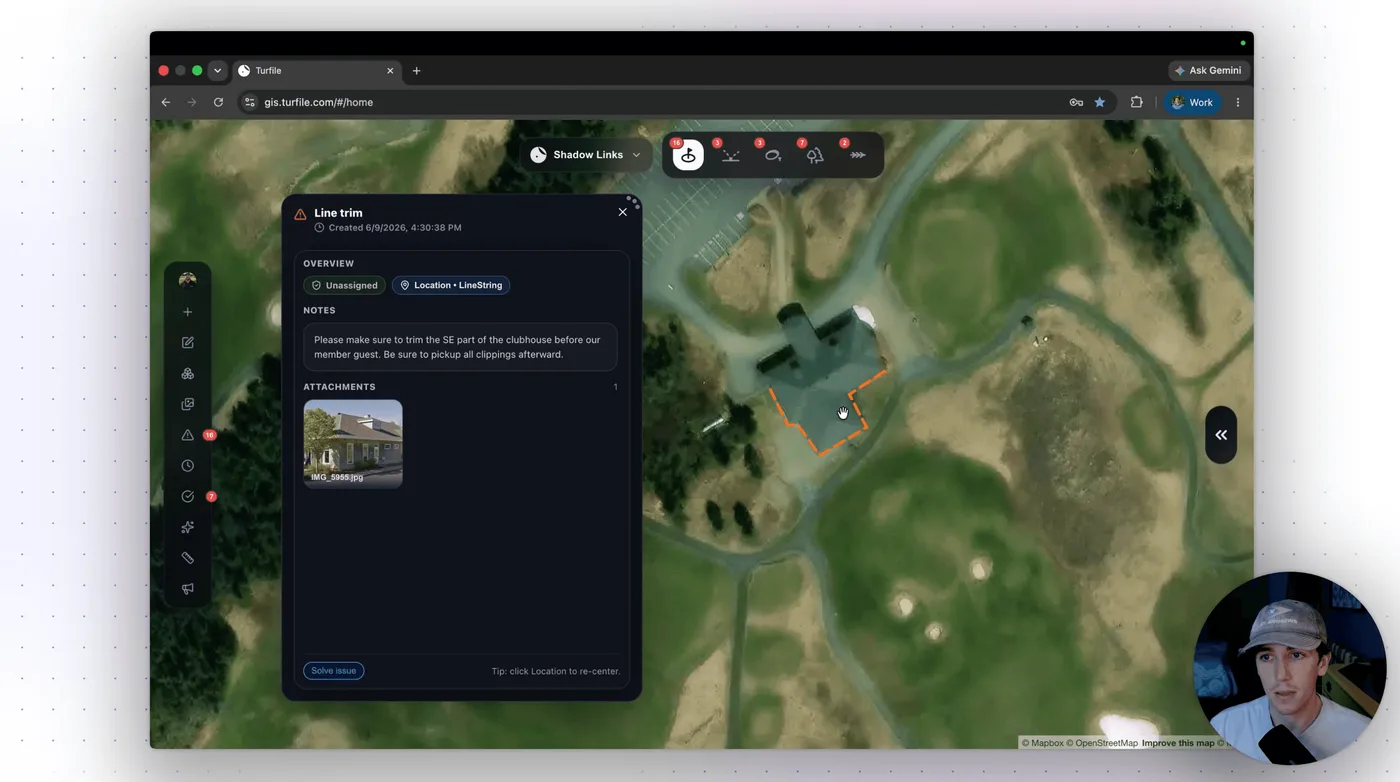
That is why issues need to be visible if you want them solved consistently. When an issue is mapped, documented, and tied to its location, it becomes much harder for it to disappear. The team can see where it is, understand what needs to happen, and update the work when it is done.
That thinking is behind issue mapping in Turfile. The goal is to give these issues a permanent, visible record without making the operation more complicated. Photos, notes, assigned work, and location context all stay together, so the team is not relying on memory or scattered communication.
Most teams already know what needs attention. The bigger challenge is making sure those things stay visible long enough to get handled.
Once an issue is visible, it is a lot easier to solve.